

Character profile sheet
In this blog post I present the first tool, in order to encourage narrative transport. It is a tool that I lacked when I started writing my books. It is a character profile sheet. I created one myself and decided to offer it to anyone who needs it.
What is it for?
First of all, you may be wondering: what is a character sheet? Well, it is a document in which you can organise the most important information about a character. Either in the form of columns or paragraphs or fields. A character profile sheet is something like a ‘character description’ in role-playing games.
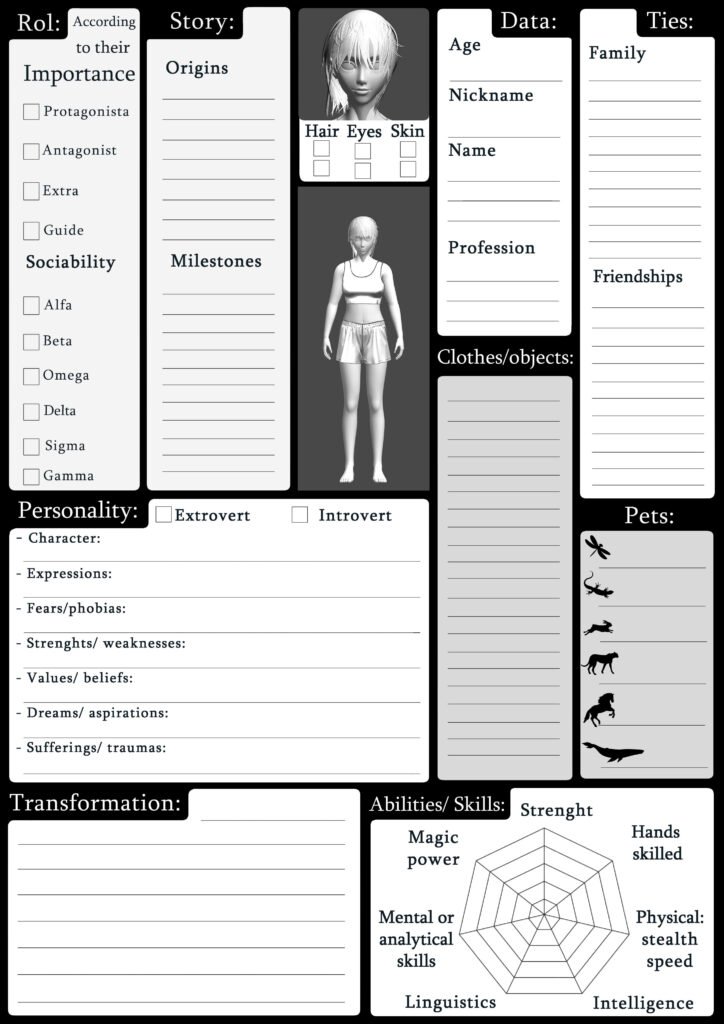
I’m sure you are also thinking about the use of such a sheet. How can you achieve a better narrative transportation with it? What are the advantages of filling in such a sheet? Is it important to decide and write down all this information before starting to write a story? Honestly, it is not easy to answer these questions. Some authors will tell you NO. Mainly because this kind of data is only relevant for the author and not for the readers. But once written down, somewhere, the author of the story will not forget it, and can refer to it whenever the author wants to. So you might as well have a notebook as a character profile sheet. After all, it’s the same thing. However, I don’t think it’s like that.
Good authoring practices
In my opinion, those who say that filling out a character sheet is not useful are wrong in one simple aspect. They do not consider the omnicscience of the author. It’s important to make short notes about your own characters, and that’s fine for short stories or even for flat characters. Even for characters with little backstory or secondary characters. But when it comes to protagonists, personalising them becomes more difficult. And it is in this case that the notes fall short.
In the world of storytelling, good authors want to create characters with depth; with background, who inspire both love and hate or affinity in the reader; who move the readers, who grow, who transform. This can only be achieved if you know from the beginning who your characters are. The author must know them as if they were best friends, brothers or sisters. Know them as if they were himself or herself. And in order to take into account so many things about someone, it is very useful and advisable to have a way of visualising everything at a glance. Therefore I highly recomned to use character sheets.
Explanation of the sheet
To get to a deeper level of knowledge of a character, an author can collect the data in the fields. Starting with the column in the top left corner you can select the role the character plays. First, according to his or her importance in the plot and then according to his or her sociability. Each of the columns is self-explanatory with the legend written in white on a black background. In total there are seven categories of which I have already explained one. The rest are explained below:
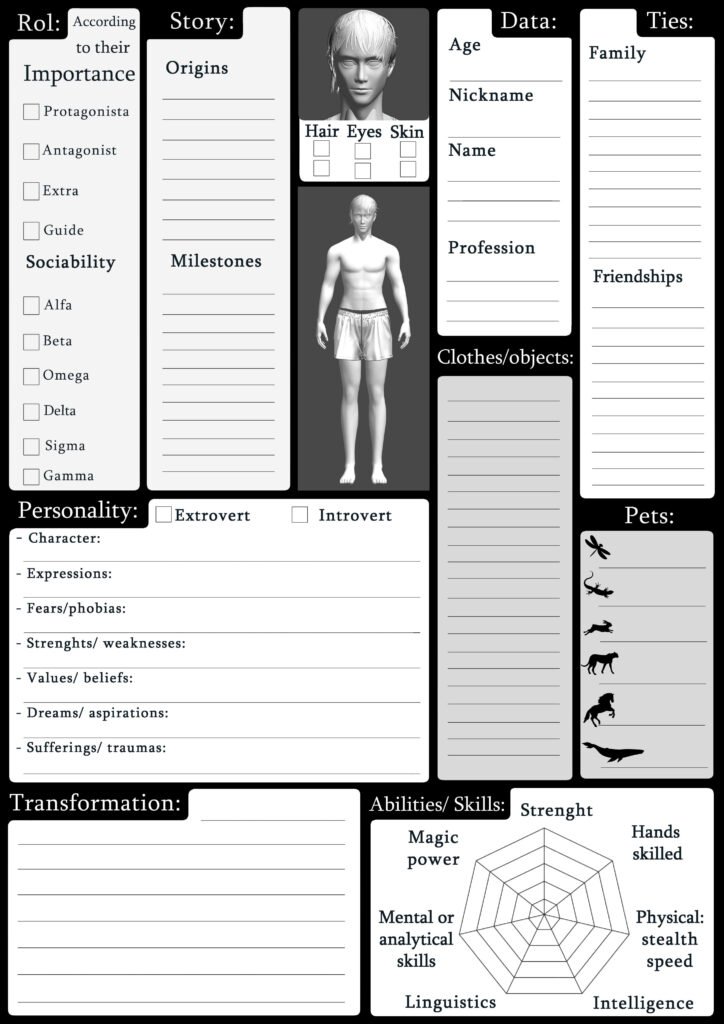
The rest of the fields to fill in are: the character’s history, with his or her origins and important milestones in his or her life; the character’s main data, such as age, nickname, name and profession; the character’s personal ties, both family and friendships or romantic interests; the clothes, objects and pets he or she has can also be written down in separate columns; and the personality box delves into many of the character’s deep aspects: whether they are extroverted or introverted, their character, typical expressions, their fears or phobias, their strenghts or weaknesses, their values or beliefs, their dreams or aspirations and their sufferings or traumas.
Last explanations and recomendations
In the top centre of the character sheet is the possibility to describe both the appearance of the character’s face and body, using a 3D model. And the pet field is divided into six categories, represented by figures: the dragonfly represents invertebrates or insects, the lizard represents reptiles, the rabbit represents small animals, the cheetah represents felines, the horse represents any kind of mounted animal, and the whale represents any marine animal. In the bottom right corner is a diagran in which the knots between the lines indicate the level 0 to 5 of the skill shown on the outside of the heptagonal diagram. The last field is identified as the character’s transformation, which will be explained below.
Such character profile sheets are very useful when you are writing the story and you suddenly have to remember, for example, what clothes the character is wearing, what colour their eyes are, what was the name of her or his mother… but above all, the transformation part of the character is crucial to keep the objective of the narrative in focus. A story in which the character does not change, neither for the better nor for the worse, becomes flat and even uninteresting. That’s why I’ve left a big space in the bottom left corner, where you can write the initial idea about the kind of transformation you want to show in the character and how it’s going to hapen.
For the moment in this article I leave two images. The sheets, of different genres, these are downloadable in PDFs, so that anyone can use them. I hope they will help you as much as they have helped me. For any changes or suggestions for improvement, please leave a comment.
Leave a Reply